


Lawrence F. Brass, MD, PhD
Professor of Medicine (Hematology-Oncology)
Department: Medicine
Graduate Group Affiliations
Contact information
Room 815, BRB II/III
421 Curie Blvd.
Philadelphia, PA 19104
421 Curie Blvd.
Philadelphia, PA 19104
Office: (215) 573-3540
Lab: 215-573-3541
Lab: 215-573-3541
Email:
brass@mail.med.upenn.edu
brass@mail.med.upenn.edu
Publications

Education:
A.B. (Chemistry)
Harvard College, 1970.
Ph.D. (Biochemistry)
Case Western Reserve University, 1975.
M.D.
Case Western Reserve, 1977.
A.B. (Chemistry)
Harvard College, 1970.
Ph.D. (Biochemistry)
Case Western Reserve University, 1975.
M.D.
Case Western Reserve, 1977.
Links
Search PubMed for articles
Hematology/Oncology Faculty
Pharmacological Sciences Graduate Group
Biochemistry and Molecular Biophysics Graduate Group
Cell and Molecular Biology Graduate Group
Lab website
Search PubMed for articles
Hematology/Oncology Faculty
Pharmacological Sciences Graduate Group
Biochemistry and Molecular Biophysics Graduate Group
Cell and Molecular Biology Graduate Group
Lab website
Post-Graduate Training
Intern in Medicine, University Hospitals of Cleveland, 1976-1977.
Resident in Medicine, University Hospitals of Cleveland, 1977-1979.
Fellow in Hematology-Oncology, University of Pennsylvania , 1979-1982.
Permanent linkIntern in Medicine, University Hospitals of Cleveland, 1976-1977.
Resident in Medicine, University Hospitals of Cleveland, 1977-1979.
Fellow in Hematology-Oncology, University of Pennsylvania , 1979-1982.
Description of Research Expertise
CVI Program Unit Administrator:Thrombosis / Hemostasis
Research Interests
mechanisms of thrombosis
Key Words: platelets, coagulation, vascular biology, signal transduction, systems biology, proteomics, transgenic mice, megakaryocytes, intravital microscopy.
Description of Research
My longstanding research and clinical interest is in platelet biology and the mechanisms of platelet activation in response to vascular injury and disease. Platelets are blood cells best known for their role in halting bleeding after vascular injury, but they do many other things as well, not all of which are healthy for humans. People that lack platelets are at risk for life-threatening bleeding. People that have platelets are at risk for the kinds of acute arterial thrombosis that leads to heart attacks and strokes, especially in the setting of atherosclerotic cardiovascular disease. Our goal is to understand the former and prevent the latter. The work we are doing focuses on human biology and pathology, but makes extensive use of genetically engineered mouse models and systems biology approaches as well. Studies currently funded by the NIH Heart, Lung and Blood Institute (NHLBI) and the American Heart Association include efforts to understand how platelet activation is initiated and regulated, how contacts between activated platelets foster thrombus growth and stability, in part by establishing a protected local environment, and how differences among platelets affect responses to injury. Methods that we employ range from the manipulation of gene expression in megakaryocytes to intravital high resolution confocal microscopy and computerized modeling. Campus collaborations include strong links to the School of Engineering and to investigators in the Departments of Medicine, Pediatrics and Pharmacology. Potential rotation and thesis projects can be identified in any of these areas.
Lab Rotation Topics
Changing all the time, so if this area of investigation sounds interesting to you, come by for a chat.
Current Laboratory Personnel:
Timothy J. Stalker, PhD - Research Assistant Professor
Peisong Ma, PhD - Senior Research Investigator
Jie Wu - Research Specialist
John Welsh - Graduate Student
Tom Colace, PhD - Postdoctoral Investigator
Sara Sampietro, PhD - Postdoctoral Investigator
Selected Publications
Welsh John D, Stalker Timothy J, Voronov Roman, Muthard Ryan W, Tomaiuolo Maurizio, Diamond Scott L, Brass Lawrence F: A systems approach to hemostasis: 1. The interdependence of thrombus architecture and agonist movements in the gaps between platelets. Blood 124(11): 1808-15, Sep 2014 Notes: Epub 2014 June 20.Tomaiuolo Maurizio, Stalker Timothy J, Welsh John D, Diamond Scott L, Sinno Talid, Brass Lawrence F: A systems approach to hemostasis: 2. Computational analysis of molecular transport in the thrombus microenvironment. Blood 124(11): 1816-23, Sep 2014 Notes: Epub 2014 June 20.
Stalker Timothy J, Welsh John D, Tomaiuolo Maurizio, Wu Jie, Colace Thomas V, Diamond Scott L, Brass Lawrence F: A systems approach to hemostasis: 3. Thrombus consolidation regulates intrathrombus solute transport and local thrombin activity. Blood 124(11): 1824-31, Sep 2014 Notes: Epub 2014 June 20.
Wannemacher K M, Jiang H, Hess P R, Shin Y, Suzuki-Inoue K, Brass L F: An expanded role for semaphorin 4D in platelets includes contact-dependent amplification of Clec-2 signaling. Journal of thrombosis and haemostasis : JTH 11(12): 2190-3, Dec 2013.
Brass Lawrence F, Tomaiuolo Maurizio, Stalker Timothy J: Harnessing the platelet signaling network to produce an optimal hemostatic response. Hematology/oncology clinics of North America 27(3): 381-409, Jun 2013.
Voronov Roman S, Stalker Timothy J, Brass Lawrence F, Diamond Scott L: Simulation of intrathrombus fluid and solute transport using in vivo clot structures with single platelet resolution. Annals of biomedical engineering 41(6): 1297-307, Jun 2013.
Mou Peipei, Zeng Zhao, Li Qiang, Liu Xiaohui, Xin Xiaoran, Wannemacher Kenneth M, Ruan Changgeng, Li Renhao, Brass Lawrence F, Zhu Li: Identification of a calmodulin-binding domain in Sema4D that regulates its exodomain shedding in platelets. Blood 121(20): 4221-30, May 2013.
Stalker Timothy J, Traxler Elizabeth A, Wu Jie, Wannemacher Kenneth M, Cermignano Samantha L, Voronov Roman, Diamond Scott L, Brass Lawrence F: Hierarchical organization in the hemostatic response and its relationship to the platelet-signaling network. Blood 121(10): 1875-85, Mar 2013.
Welsh J D, Colace T V, Muthard R W, Stalker T J, Brass L F, Diamond S L: Platelet-targeting sensor reveals thrombin gradients within blood clots forming in microfluidic assays and in mouse. Journal of thrombosis and haemostasis : JTH 10(11): 2344-53, Nov 2012.
Flamm Matthew H, Colace Thomas V, Chatterjee Manash S, Jing Huiyan, Zhou Songtao, Jaeger Daniel, Brass Lawrence F, Sinno Talid, Diamond Scott L: Multiscale prediction of patient-specific platelet function under flow. Blood 120(1): 190-8, Jul 2012.

Contact us
Institute for Diabetes, Obesity and Metabolism
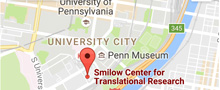
Smilow Center for Translational Research
3400 Civic Center Boulevard, 12th Floor
Philadelphia, PA 19104
Phone: 215-898-0198 | Fax 215-898-5408

Directions
© Trustees of the University of Pennsylvania