

Our Mission

The overarching mission of the Kim Lab is to facilitate the development of imaging technologies and therapeutic approaches that enable novel minimally invasive procedures. Image-guided interventions are playing an increasingly central role in medicine with applications that span organ systems and disease states. This is underscored by the breadth of specialties that have integrated these minimally invasive procedures into their practice including interventional radiology, interventional neuroradiology, neurosurgery, interventional pulmonology, interventional cardiology, interventional nephrology, urology, vascular surgery and cardiothoracic surgery among others. With this growth, advances in targeted therapies as well as device and imaging technologies have image-guided interventions poised to transform biomedicine.


The realization of this potential is critically dependent on the cross-pollination of the expertise across these fields. To date, research in image-guided interventions has been limited by the challenges aSssociated with developing facilities that integrate disverse device and imaging technologies, generating translationally relevant disease models and fostering a collaborative environment that transcends clinical specialties. The Kim Lab will overcome these limitations by incorporating a state-of-the-art preclinical procedural facility with cutting-edge science to bring together interventionalists across disciplines.
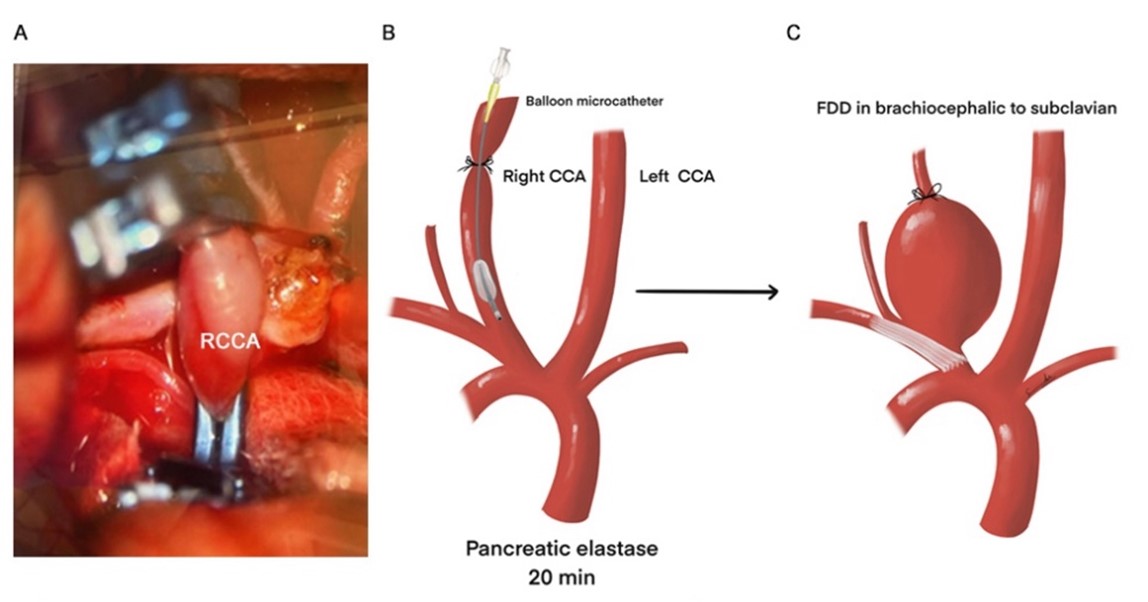
Three panels showcasing the treatment of an aneurysm.
A - Isolation of the right common carotid artery; B - Balloon catheter is advanced to the subclavian artery for protection, followed by elastase injection; C – 30 days after, the aneurysm is created and ready for surgical intervention (placement of a flow diverter).

Transcriptomics of intracranial aneurysms: current state and opportunities in flow diversion

Illustration summarizing the current understanding of FD biology from prior studies on cellular, molecular, and transcriptomic changes.

Over the last 2 decades, the field of transcriptomics has emerged as a major subdiscipline in biology. Transcriptomic techniques have been used by many groups over this time to better understand intracranial aneurysm development, rupture, and treatment. However, only a few studies have applied transcriptomics to understand the mechanisms behind flow diversion (FD) specifically, despite its increasing importance in the neurointerventional armamentarium.


FD is an increasingly safe and effective treatment option for intracranial aneurysms. However, the clinical understanding and use of FD has far outpaced the understanding of the underlying mechanisms. To make FD more predictable, clinically efficacious, and safe, it is important to understand the biological mechanisms at play that lead to successful and unsuccessful FD.


In this review, the authors focus on the current understanding of FD biology, the recent advances in transcriptomics, and what future studies could be performed to deepen the understanding of FD. They propose the new concept of the FD microenvironment to be studied, which may unlock a deeper biological understanding. This review provides the background for prospective studies into the development of targeted aneurysm therapy, whether by modified devices or by medical adjuncts.


Full Publication


Endovascular biopsy in neurointerventional surgery: A systematic review

Preferred Reporting Items for Systematic Reviews and Meta-Analyses (PRISMA) 2020 flow diagram for study selection.

Endothelial cells (EC) continuously line the cerebrovasculature. Molecular aberrations in the ECs are hallmarks and contributory factors to the development of cerebrovascular diseases, including intracranial aneurysms and arteriovenous malformations. Endovascular biopsy has been introduced as a method to harvest ECs and obtain relevant biologic information. We aimed to summarize the literature on endovascular biopsy in neurointerventional surgery.


Full Publication