


Penn Giant Cell Arteritis (Temporal Arteritis) Fast-Track Program
TRIAGE PHONE FOR CLINICIANS ONLY: 215-614-0999
EMAIL: gcafast@pennmedicine.upenn.edu
Patients who have already undergone evaluation and are receiving treatment but would like a second opinion on diagnosis and management should call: 215-662-4333
Given the high risk of rapid vision loss, we understand the importance of evaluating and managing GCA promptly. Similarly, minimizing unnecessary exposure to glucocorticoids or steroids and its many side effects is also important to patients. The goals of the GCA Fast-Track Program are:
1 |
Provide rapid evaluation of suspected new or relapsing GCA through a comprehensive, multi-disciplinary approach |
2 |
Initiate appropriate therapy promptly |
3 |
Facilitate innovative research in GCA |
How It Works in 4 Steps
- Patient presents to outpatient clinician with suspected giant cell arteritis.
- Clinician calls 215-614-0999 or places consult order in PennChart.
- GCA specialist obtains more history and provides guidance on additional evaluation. If indicated, scheduling team will contact patient to arrange appointment.
- If clinician would like assistance arranging temporal artery biopsy through Penn Vascular Surgery, our team can facilitate this. Patients are usually seen by a surgeon within one week of referral.
Services We Offer
Consultation
For referring clinicians, phone consultation with vasculitis specialist to assist with management and glucocorticoid use for patient with suspected GCA.
Evaluation
Expedited evaluation of patient with new presentation for suspected GCA.
The GCA Fast-Track Program helps to coordinate care with relevant specialists including:
- Rheumatologists
- Neuro-ophthalmologists
- Vascular surgeons for temporal artery biopsy
- Pathologists
Available treatments including non-prednisone options can be discussed. FDA-approved therapies include:
Advanced Imaging Techniques
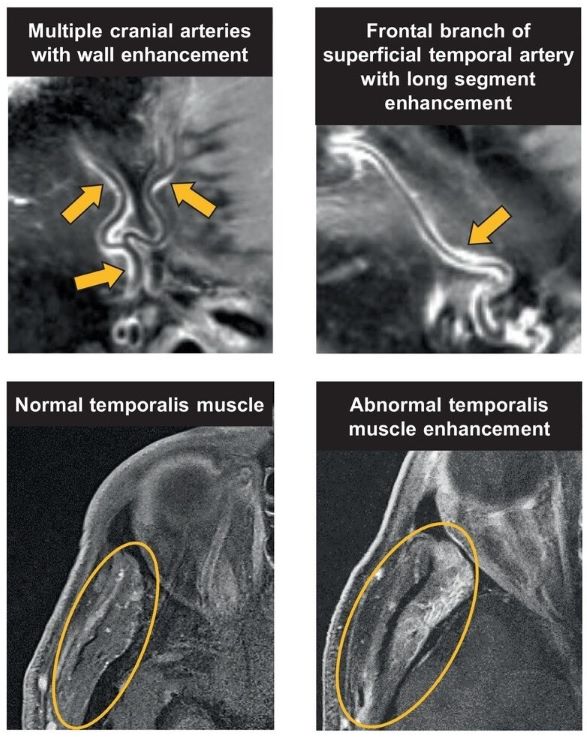
High-resolution vessel wall MRI is an advanced tool which can assess for inflammation of multiple arteries in the head and eyes. Note that this imaging technique is different from a standard brain MRI which does not contain the appropriate sequences to image the arteries in GCA. Research conducted at Penn has demonstrated the excellent diagnostic performance of vessel wall MRI for GCA. View publication.
To order vessel wall MRI for GCA:
- Penn clinicians: In PennChart, order “MR head angio giant cell arteritis with and without contrast” exam.
- Non-Penn clinicians: Order “MRA head with and without” and under comments write “giant cell arteritis vessel wall imaging.”
Locations: This specialized technique can only be done at specific Penn radiology facilities: PCAM, PPMC, Radnor call 215-662-3000
Example MR images of arterial and temporalis muscle enhancement
- Patients with a new presentation for GCA who need outpatient assistance with diagnostic evaluation including temporal artery biopsy, imaging, and/or ophthalmology evaluation.
- Patients who need urgent temporal artery biopsy
*Patients with vision loss suggestive of GCA-related eye involvement should be sent to the emergency room for prompt evaluation and treatment.
Research
Patients may have an opportunity to enroll in research studies for GCA. View enrolling studies for GCA here.