


PSOM Center on Mechanisms Underlying Cognitive Heterogeneity in Synucleinopathy
Mission
The overall goal of this Penn PO1 Center on “Mechanisms underlying heterogeneity of cognitive outcome in synucleinopathy” is to understand why the same underlying core pathology – inclusions of alpha-synuclein (aSyn) – varies so widely in the pace and pattern of spread within the brain, resulting in dramatically divergent clinical trajectories. The Lewy body disorders (LBD) – namely, dementia with Lewy bodies (DLB), Parkinson’s disease (PD), Parkinson’s disease with dementia (PDD), and, to some extent, Alzheimer’s Disease with Lewy bodies (LBD+AD) – share the central feature of neuronal aSyn inclusions. However, LBD patients manifest very differently from one another, with differences in cognition playing a vital role with respect to patient quality of life and burden to the healthcare system. Indeed, individuals with DLB manifest with cognitive symptoms, while the point prevalence of dementia in PD in the US is estimated at 30%. That said, >80% of PD patients develop cognitive impairment and/or dementia over the course of their disease, so that together the LBD represent one of the most important Alzheimer’s Disease Related Dementias (ADRD) affecting the world today.
For more information please visit our Resources page.
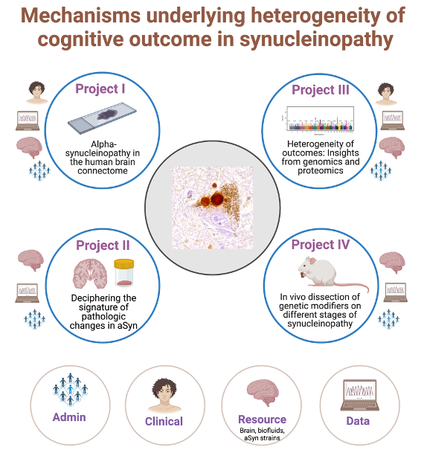
We hypothesize that key factors:
- conformation of aSyn
- interplay with AD pathology
- host features
- locus of early pathology
Determine whether a given LBD individual might develop dementia at outset, after a few years, after decades, or not at all.
We test this hypothesis through four Research Projects supported by four Cores.
Latest News
-
June 2026
A collaboration involving PO1 Project and Core Leaders Alice Chen-Plotkin, Kelvin Luk, and Edward Lee resulted in our recent report in Neuron, showing that anti-GPNMB antibodies can block formation of alpha-synuclein pathology in neurons. This work, which follows our 2022 finding that the Parkinson's disease genetic risk locus rs199347 belongs to the target gene GPNMB, and that the encoded protein GPNMB is necessary and sufficient for cells to internalize alpha-synuclein fibrils, was also featured in a Penn Medicine press release: https://www.pennmedicine.org/news/immune-protein-a-possible-target-to-slow-parkinsons-disease.
PO1 PI Alice Chen-Plotkin was recently appointed to the Federal Advisory Council on Parkinson’s Research, Care, and Services, charged by Congress to advise on the National Plan to End Parkinson’s. The inaugural meeting took place on June 29, 2026.
Daniel Weintraub, Clinical Core Leader, and the team's recent publication of PDAQ-27 uses Clinical Core participants to validate, and is being used in PPMI study as well.
"The Penn Parkinson’s Daily Activities Questionnaire-27 (PDAQ-27) is a 27-item measure of cognitive instrumental activities of daily living (IADLs) for Parkinson’s disease (PD) patients developed by integrating 12 additional items with the original 15-item PDAQ-15 via mixed-methods research with the goal of creating a more balanced and sensitive instrument. Results presented in this paper show that the PDAQ-27 is a promising measure of cognition-related IADLs in patients with PD, with solid cross-sectional psychometric performance."
The full paper can be read here.
March 2026
Congratulations to Dr. Esteban Luna, MD, PhD! He is a recipient of the 2026 Next Generation Research Grant from the American Brain Foundation, Alzheimer’s Association, and American Academy of Neurology in Lewy body dementia. https://www.americanbrainfoundation.org/2026-next-generation-research-grant-recipients
PO1 investigators Alice Chen-Plotkin, George Kannarkat, and Kelvin Luk, together with Miranda Lim of Oregon Health and Science University and David Walt of Harvard Medical School, were awarded the American Brain Foundation Cure One Cure Many Award in Lewy Body Dementia for their efforts to develop biomarkers for Lewy Body Dementia diagnosis. You can read more about it here: https://www.americanbrainfoundation.org/2026-cure-one-cure-many-awards/#lewy.
November 2025
PO1 Resource Core Director Edward Lee's work on air pollution and effects on neurological symptoms is featured in the New York Times. (Link to NYTimes)
October 2025
On Friday, October 17, 2025, PO1 Center Investigators gathered at a Symposium to celebrate the many accomplishments of Project II Leader Virginia Lee. Trainees from all eras of her illustrious career gave talks on neurodegeneration and the impact she has had on their careers. Click here for more info.
2025
Drs. Tropea, Irwin and Weintraub were recently awarded a grant from The Michael J. Fox Foundation for Parkinson’s Research and its Neuronal Synuclein Disease Endotypes 2024 program for a project titled "Examining the role of concomitant Alzheimer's on alpha-synuclein pathological burden". The $400,000 grant is examining the role of concomitant Alzheimer's disease pathology on alpha-synuclein pathological burden. This grant will utilize clinical, biomarker and pathology data from the NIA P01.
June 2025
Center investigators Alice Chen-Plotkin and George Kannarkat show that alpha-synuclein conformations in plasma may differ between Parkinson's Disease and Dementia with Lewy Bodies. In collaboration with the David Walt lab at Harvard, center investigators develop methods to measure alpha-synuclein in plasma extracellular vesicles.
May 2025
Center Investigator Alice Chen-Plotkin, collaborating with Dan Weintraub, Eddie Lee, and Vivianna Van Deerlin, links Parkinson’s disease genetic risk variants to lysosomal biomarker measures.
April 2025
Core Leader Sharon Xie develops new approaches to Cox regression.
September 2024
Center Investigator Virginia Lee offers her take on synucleinopathies in a new review in Neuron.” Red text should be linked to take on synucleinopathies in a new review in Neuron.
Clinical Core Leader Dan Weintraub leads a study investigating long-term dementia risk in Parkinson's disease and finds that dementia in PD occurs less frequently, or later in the disease course, than previous studies have indicated.
March 2024
Center Investigator David Irwin, collaborating with Alice Chen-Plotkin, Virginia Lee, Eddie Lee, and Dan Weintraub, investigates tau maturation in Lewy body disease and Alzheimer’s disease with digital histology.
Our program is funded by the National Institute on Aging. You can read the full article here.