
Fellowship in Undersea and Hyperbaric Medicine
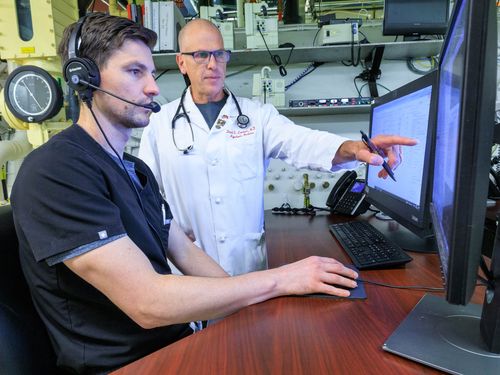 The Fellowship in Undersea and Hyperbaric Medicine is an ACGME-accredited one-year program. The fellowship is designed to provide licensed physicians the opportunity to be educated and trained in the theory and practice of diving and hyperbaric medicine. Individuals successfully completing the one-year fellowship will obtain sufficient didactic and practical knowledge to work efficiently and competently in a hyperbaric clinical and research environment, to act in a supervisory capacity of a hyperbaric chamber, and meet eligibility requirements to sit for the American Board of Medical Specialists' certification examination.
Program Goals
The subspecialty of Undersea and Hyperbaric Medicine deals with the therapeutic use of high environmental oxygen pressure and the prevention of injury and illness due to exposure to environments with elevated ambient pressure. The scope of the subspecialty emphasizes occupational, environmental, safety, and clinical aspects of diving, hyperbaric chamber operations and hyperbaric oxygen (HB02) therapy. At completion of the fellowship, the trainee will:
- Develop a knowledge base and clinical skills necessary to:
- Evaluate and prescribe appropriate HB02 therapy for all the medical conditions accepted by the Undersea and Hyperbaric Medical Society as amenable to treatment.
- Manage patients during hyperbaric treatment.
- Evaluate individuals for scuba diving activities and treat diving-related illnesses.
- Discuss investigational indications for the use of HB02 and areas for future research.
- Develop requisite academic skills to be an effective teacher and researcher in diving and hyperbaric oxygen therapy.
Fellowship Requirements
Fellowship candidates must be graduates of an accredited residency and hold or obtain a valid medical license for the state of Pennsylvania. The educational program is designed for two fellows per year. The core focus is participation in clinical and research activities of the Division of Undersea and Hyperbaric Medicine, Department of Emergency Medicine, Perelman School of Medicine, University of Pennsylvania.
Curriculum
- Required clinical activities:
- Participate in HBO2 clinical operations by monitoring daily treatment sessions and emergency on-call treatments.
- Provide consultation service to physicians referring patients
- Participate in weekly clinics including wound care, vascular surgery, plastic surgery, and diving medicine.
- Didactic curriculum and HBO2 core lecture series:
- Weekly clinical rounds discussion.
- Weekly Grand Rounds.
- Bi-weekly hyperbaric medicine lecture series including formal lectures, literature review, and Undersea and Hyperbaric Medicine text reviews.
- Development of four lectures for demonstration of knowledge in core curriculum subjects. These will be presented at community hospitals, rotating resident lectures, in-house grand rounds, and inter-fellowship web conferences.
- Required participation in one or more on-going research project. Based on a fellow’s prior training and interests, a new project may be developed and funded by internal resources.
- Elective clinical opportunities.
Core Content
- History of pressure therapy in medicine
- Physiologic effects of hyperbaric oxygen
- Increase in healing of hypoxic wounds
- Inhibition of Clostridial alpha toxin
- Lessening carbon monoxide toxicity
- Influence on various blood cells
- Vasoconstriction
- Decrease in edema in burns and post-ischemic tissue
- Preservation of tissue flaps
- Decrease in lipid peroxidation
- Inhibit PMN adherence/role of HBO2 in ischemia reperfusion injuries
- Mechanical effects of pressure
- Reduce bubble volume
- Inert gases, supersaturation, re-dissolving nitrogen bubble
- Oxygen toxicity
- Multiplace chamber operation
- Equipment considerations
- Patient considerations
- Emergency procedures
- Monoplace chamber operation
- Equipment considerations
- Patient considerations
- Emergency procedures
- Approved indications for hyperbaric oxygen therapy
- Air or gas embolism
- Carbon monoxide poisoning
- Carbon monoxide poisoning complicated by cyanide poisoning
- Clostridial myonecrosis
- Acute traumatic ischemia
- Decompression sickness
- Enhancement of healing in selected problem wounds
- Exceptional blood loss
- Necrotizing soft tissue infections
- Refractory osteomyelitis
- Radiation tissue damage
- Compromised skin grafts and flaps
- Thermal burns
- Contraindications and side effects of HBO
- Absolute
- Untreated pneumothorax
- Relative
- COPD with CO2 retention, bullous disease
- Selected medications (e.g. bleomycin)
- Seizure disorder
- Recent thoracic surgery
- Recent ear or sinus surgery
- Cataracts
- Claustrophobia
- Side effects
- Barotrauma (otic, sinus, pulmonary)
- Visual refractive changes
- Oxygen induced seizures and other CNS effects
- Claustrophobia
- Pulmonary oxygen toxicity
- Absolute
- Tissue oxygen measurements – Transcutaneous oximetry
- Investigational areas (examples)
- Ischemia reperfusion injury
- Myocardial infarction
- Cerebrovascular accident
- Care of the critically ill patient in a hyperbaric chamber
- Drugs and critical care equipment under pressure
- Nursing considerations
- Resuscitation management
- Hyperbaric medicine in pediatric practice
- Indications for HBO in children
- Special contraindications
- Psychological preparation and support
- Physiologic effect of pressure and immersion
- Physics of diving
- Hypothermia and hyperthermia
- High pressure nervous syndrome
- Breath-hold diving
- Decompression Theory
- Inert gas exchange
- Mechanisms of bubble formation
- Saturation decompression theory
- Repetitive diving
- Surface decompression
- Bubble detection
- Mixed gas diving
- Altitude diving, flying after diving
- Pathophysiology and treatment of decompression illnesses
- Signs and symptoms of decompression sickness and AGE
- Mechanisms of gas entry and distribution
- Effects of bubbles
- Dysbaric osteonecrosis
- Barotrauma
- Treatment of decompression illnesses
- Health hazards in divers
- Medical examination and standards for hyperbaric exposure: Military, commercial, recreational, scientific, hyperbaric personnel
- Recognition and treatment of hazardous marine life injuries
Former Fellows
| 1991 – 1992 | Robert Taber, M.D. | Mid Valley Hospital Omak, WA |
| 1992 – 1993 | Ignacio Mendiguren, M.D | Inova Loudon Hospital Leesburg, VA |
| 1993 – 1994 | Kevin Hardy, M.D | Penn Undersea and Hyperbaric Medicine Philadelphia, PA |
| 1999 – 2000 | Enoch Huang, M.D. | Legacy Emanuel Medical Center Portland, OR |
| 1999 – 2001 | James Martin, M.D. | Cullman Regional Medical Center Cullman, AL |
| 2004 – 2005 | Ed Johnson, M.D. | California medical detachment Seaside, CA |
| 2004 – 2005 | Alan Lewis, M.D. | Kaiser Permanente Panorama City Medical Center Panorama City, CA |
| 2005 – 2006 | Christopher Logue, M.D. | Hennepin County Medical Center Minneapolis, MN |
| 2005 – 2006 | Matthew Ellis, M.D. | HCA Florida North Florida Hospital Gainesville, FL |
| 2006 – 2007 | Vincent McCarthy, M.D. | LeConte Medical Center Pigeon Forge, TN |
| 2006 – 2007 | Byoung Yang, M.D. | BY Wound Care Internal Medicine White Plains, NY |
| 2007 – 2008 | David Lambert, M.D. | Penn Undersea and Hyperbaric Medicine Philadelphia, PA |
| 2007 – 2008 | Marvin Heyboer, M.D | SUNY Upstate Emergency Department Syracuse, NY |
| 2008 – 2009 | Matthew Partrick, M.D. | EM Pros St. Augustine, FL |
| 2008 – 2009 | Ed Choi, M.D. | Northwell Health Bay Shore, NY |
| 2009 – 2010 | Jeannie Le, M.D. | University of Texas Medical Branch Galveston, TX |
| 2009 – 2010 | Mike Madsen, D.O. | Tripler Army Medical Center Honolulu, HI |
| 2009 – 2010 | Caesar Anderson, M.D. | UCSD Encinitas, CA |
| 2010 – 2011 | Jawad Kassem, M.D. | Phelps Memorial Hospital Sleepy Hollow, NY |
| 2010 – 2011 | Kevin Buford, M.D. | Ochsner Health |
| 2011 – 2012 | Syed Naqvi, M.D. | Advanced Medicine Clinics New York, NY |
| 2012 – 2013 | Katina Fosen, M.D. | Advent Health Tampa, FL |
| 2012 – 2013 | Humberto Villalvazo, M.D. | Community Medical Center Selma, CA |
| 2013 - 2014 | Stephen Hendrickson, M.D. | Kent Hospital Warwick, RI |
| 2013 - 2014 | Diane Truong, M.D. | BronxCare Hospital Center New York, NY |
| 2014 – 2015 | Yolanda Michetti, M.D. | UPMC Wound Care Mechanicsburg, PA |
| 2014 – 2015 | Gerald Godfrey, M.D. | Aurora Hyperbaric Medicine Milwaukee, WI |
| 2015 – 2016 | Jason Chiu, M.D. | Mount Sinai Brooklyn Hospital New York, NY |
| 2015 – 2016 | Miguel Aguilera, M.D. | St Mary's Hospital Centralia, IL |
| 2016 – 2017 | Mark Binkley, M.D. | Penn Undersea and Hyperbaric Medicine Philadlephia, PA |
| 2017 – 2018 | Mala Trivedi, M.D. | USF Tampa, FL |
| 2017 – 2018 | Stephanie Merrick, M.D. | Jefferson Lansdale Hospital Lansdale, PA |
| 2018 - 2019 | Zack Gaskill, D.O. | Penn Undersea and Hyperbaric Medicine Philadelphia, PA |
| 2019 - 2020 | Syed Ahmad M.D. | Mercy Hospital Miami, FL |
| 2019 - 2020 | Mike Tom M.D. | Team Health Seattle, WA |
| 2020 - 2021 | Kin Wah (Adrian) Chew, M.D. | University of Maryland Medical System Baltimore, MD |
| 2020 - 2021 | Kinjal Sethuraman, M.D. | R Adams Cowley Shock Trauma Baltimore, MD |
| 2021 - 2022 | Jonathan Romero M.D. | Carolina, PR |
| 2022 - 2023 | Samuel Hawkins M.D. | The Ohio State University Columbus, OH |
| 2023 - 2024 | Emma Rogers M.D. | Penn Undersea and Hyperbaric Medicine Philadlephia, PA |
| 2024 - 2025 | Shelby Crowley D.O. | Jefferson Health Wound Care Center Cherry Hill, NJ |
| 2024 - 2025 | Yimage Ahmed M.D. | UT Health San Antonio, TX |
Current Fellows (2025-2026)