


Home
Mission
The mission of the Center for Neurodegenerative Disease Research (CNDR) is to promote and conduct multidisciplinary clinical and basic research to increase the understanding of the causes and mechanisms leading to brain dysfunction and degeneration in neurodegenerative diseases such as Alzheimer’s disease (AD), Parkinson’s disease (PD), Lewy body dementia (LBD), Frontotemporal degeneration (FTD), Amyotrophic lateral sclerosis (ALS), Primary lateral sclerosis (PLS), Motor neuron disease (MND), and related disorders that occur increasingly with advancing age. Implicit in the mission of the CNDR are two overarching goals: 1.) Find better ways to cure and treat these disorders, 2. Provide training to the next generation of scientists.
“My vision for CNDR is to create a world with effective interventions to prevent and cure aging-related neurodegenerative diseases.” – Eddie Lee, MD, PhD, Director of CNDR
John Q. Trojanowski, MD, PhD | 1946 - 2022
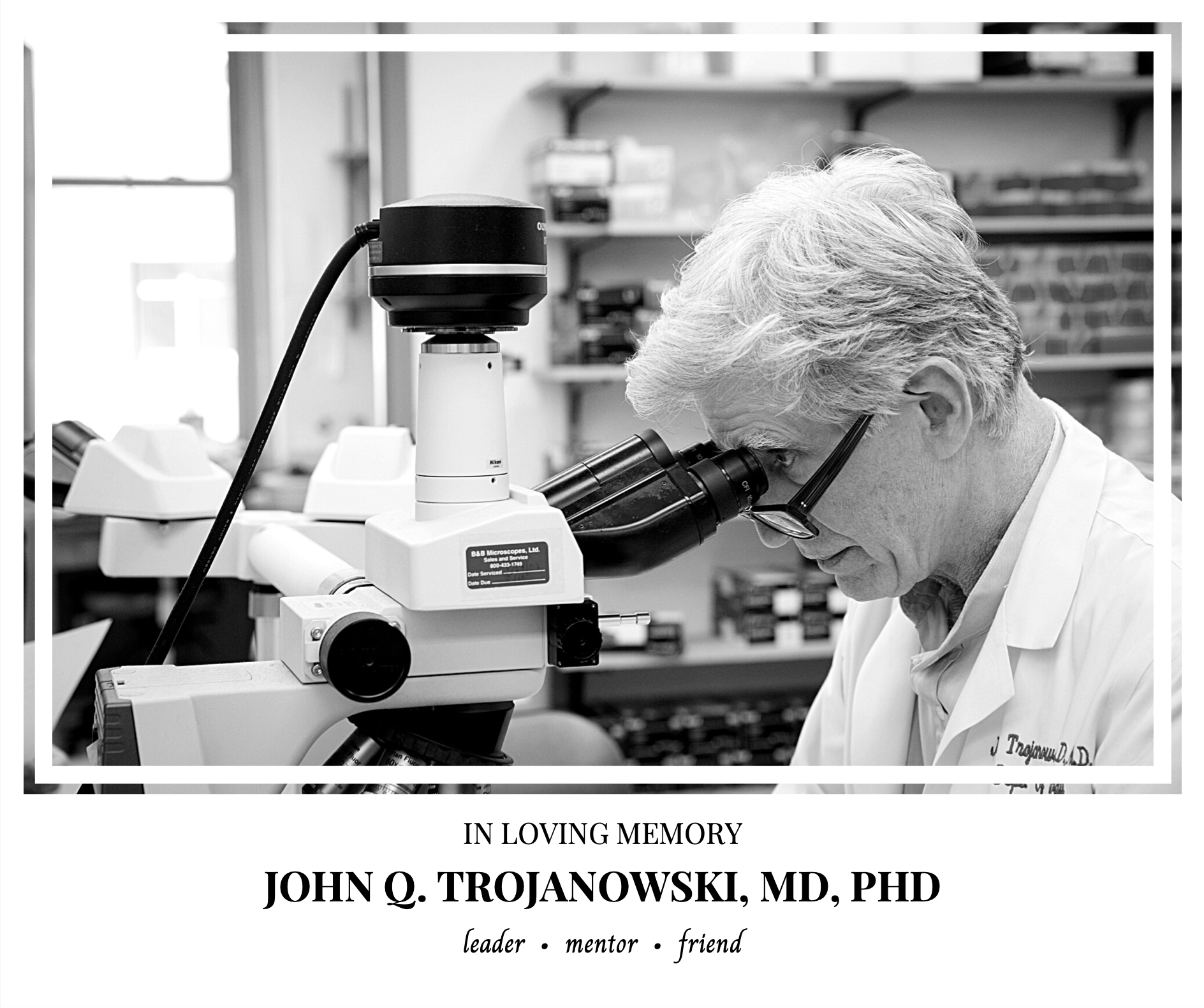
In loving memory of John Q. Trojanowski, MD, PhD
Latest Research
-
The Impact of Participation in the Parkinson's Pals Program on Psychosocial Symptoms in Parkinson's Disease: An Unblinded Feasibility Study
Wednesday, April 1, 2026
CONCLUSIONS: Participation in Parkinson's Pals was feasible, reduced loneliness and demoralization in pwPD, and enhanced student education. Further studies are needed to explore the psychosocial benefits of intergenerational programs for pwPD.
-
ATF3-dependent formation of inclusion bodies in polyQ-expressing human iPSC-derived neurons confers cellular protection
Wednesday, April 1, 2026
Huntington's disease (HD) is an incurable, neurodegenerative disorder. While the causative mutation - CAG expansions within the coding region of the Huntingtin (HTT) gene - has been identified over 30 years ago, the pathological mechanisms underlying HD are still not clear. The abnormal CAG track encodes a polyglutamine (polyQ) expanded protein, which leads to HTT protein misfolding. These polyQ aggregates can form insoluble inclusion bodies (IBs); however, whether IBs are protective or...
-
Long-Term Outcomes of Subthalamic Nucleus and Globus Pallidus Interna Deep Brain Stimulation for Young-Onset Parkinson Disease
Monday, March 30, 2026
BACKGROUND AND OBJECTIVES: Patients with young-onset Parkinson disease (YOPD) commonly experience early motor complications necessitating deep brain stimulation (DBS), and the subthalamic nucleus (STN) and globus pallidus interna (GPi) are the primary DBS targets used for reducing medication use and addressing dyskinesias. This study leveraged both the University of Florida Fixel Institute high volume of DBS operations and the INFORM database to evaluate motor outcomes in a large cohort of...