
TRIDENT2.0
The Next Phase of Precision Kidney Research
TRIDENT 2.0 represents the next evolution of the TRIDENT platform. Building on the foundational discoveries and infrastructure established in TRIDENT 1.0, this phase extends tissue-anchored investigation toward therapeutic modulation, spatial biology, and translational readiness.
From disease characterization to therapeutic biology
TRIDENT 1.0 established that diabetic kidney disease is biologically heterogeneous and that kidney tissue–derived molecular features are tightly linked to clinical outcomes. TRIDENT 2.0 moves beyond disease classification to ask a new set of questions: how do disease-modifying therapies alter kidney biology, and which molecular pathways define response or resistance?
This shift positions TRIDENT to directly inform precision treatment strategies in diabetic kidney disease.
Therapy-informed molecular profiling
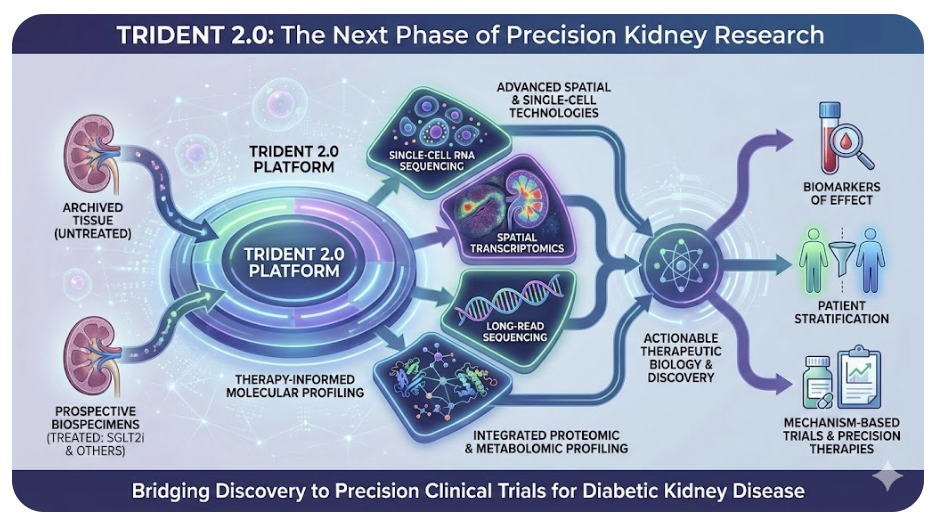
TRIDENT 2.0 integrates kidney tissue and biospecimens from patients exposed to contemporary disease-modifying therapies, including SGLT2 inhibitors and related agents. By analyzing kidney molecular programs in treated and untreated contexts, TRIDENT 2.0 aims to define therapy-responsive pathways and identify biomarkers of therapeutic effect.
This approach enables direct assessment of how treatments modify kidney biology rather than relying solely on downstream clinical endpoints.
Advanced spatial and single-cell technologies
A central component of TRIDENT 2.0 is the application of next-generation technologies to resolve cellular and spatial complexity within the human kidney. These include:
-
Single-cell RNA sequencing to define cell-type–specific injury and repair programs
-
Spatial transcriptomics to map molecular states within intact tissue architecture
-
Long-read sequencing to resolve transcript isoforms and regulatory complexity
-
Integrated proteomic and metabolomic profiling to capture functional pathway activity
Together, these approaches provide a multi-dimensional view of kidney disease biology at unprecedented resolution.
Leveraging archived and prospective clinical tissue
TRIDENT 2.0 leverages both newly collected biopsies and archived clinical tissue linked to rich longitudinal outcomes. This strategy enables efficient scaling of discovery while preserving continuity with prior TRIDENT cohorts and analyses.
The ability to interrogate archived human kidney tissue using modern technologies substantially accelerates translational discovery.
Enabling biomarkers, stratification, and trials
By integrating tissue biology, molecular profiling, and clinical outcomes in treated and untreated populations, TRIDENT 2.0 is designed to:
-
Identify biomarkers that reflect on-target therapeutic effects
-
Stratify patients based on molecular response profiles
-
Inform mechanism-based clinical trial design
-
Support development of precision therapies for diabetic kidney disease
A platform for continued discovery
TRIDENT 2.0 is not a separate study, but an extension of a unified, evolving platform. As new therapies and technologies emerge, the TRIDENT framework is designed to adapt while maintaining rigorous linkage between human kidney biology and patient outcomes.
Why TRIDENT 2.0 matters
TRIDENT 2.0 advances the field from descriptive pathology toward actionable therapeutic biology. By directly interrogating how treatments reshape kidney molecular pathways in humans, this phase establishes a critical bridge between discovery, biomarkers, and precision clinical trials in diabetic kidney disease.
© The Trustees of the University of Pennsylvania | Site best viewed in a supported browser. | Report Accessibility Issues and Get Help | Privacy Policy | Site Design: PMACS Web Team.